
‘Tears of the Kingdom is a game that suffers under the weight of its predecessor’
Receiving massive acclaim since it’s release, 2023 will be remembered as the year of Tears of the Kingdom. It’s been out for over two months and my Instagram feed is still littered with footage, from ultrahand creations pushing the boundaries the game’s systems, to the many many korok torture devices, each more dastardly than the last. With the excess of media coverage, there’s little that hasn’t already been said, yet I find myself in the minority by feeling somewhat cold towards this critical success. Feelings of disappointment that started within the first couple of hours have only broadened during my time with the latest instalment in a franchise that I have great affection for. Breath of the Wild is one of my all time favourite games and one of the few games that I have played to completion (finding 900 korok seeds not withstanding, I don’t hate myself.)
Speaking of it’s predecessor, stop me if this sounds familliar. In Tears of the Kingdom, Link and Zelda face off with a powerful evil and are defeated, leaving Link heavily injured and Zelda seperated from Hyrule due to her magical princess powers. Link recovers during a long slumber, obtains a piece of ancient technology, and discovers himself in a small isolated location. Guided by the spirit of a departed king, Link must travel to four shrines which grant him new abilities. This task completed, Link can traverse Hyrule and must visit each of the four non-Hylian races and help them. As a reward for his aid, he gains another supernatural ability and something that will make the game’s final confrontation easier.
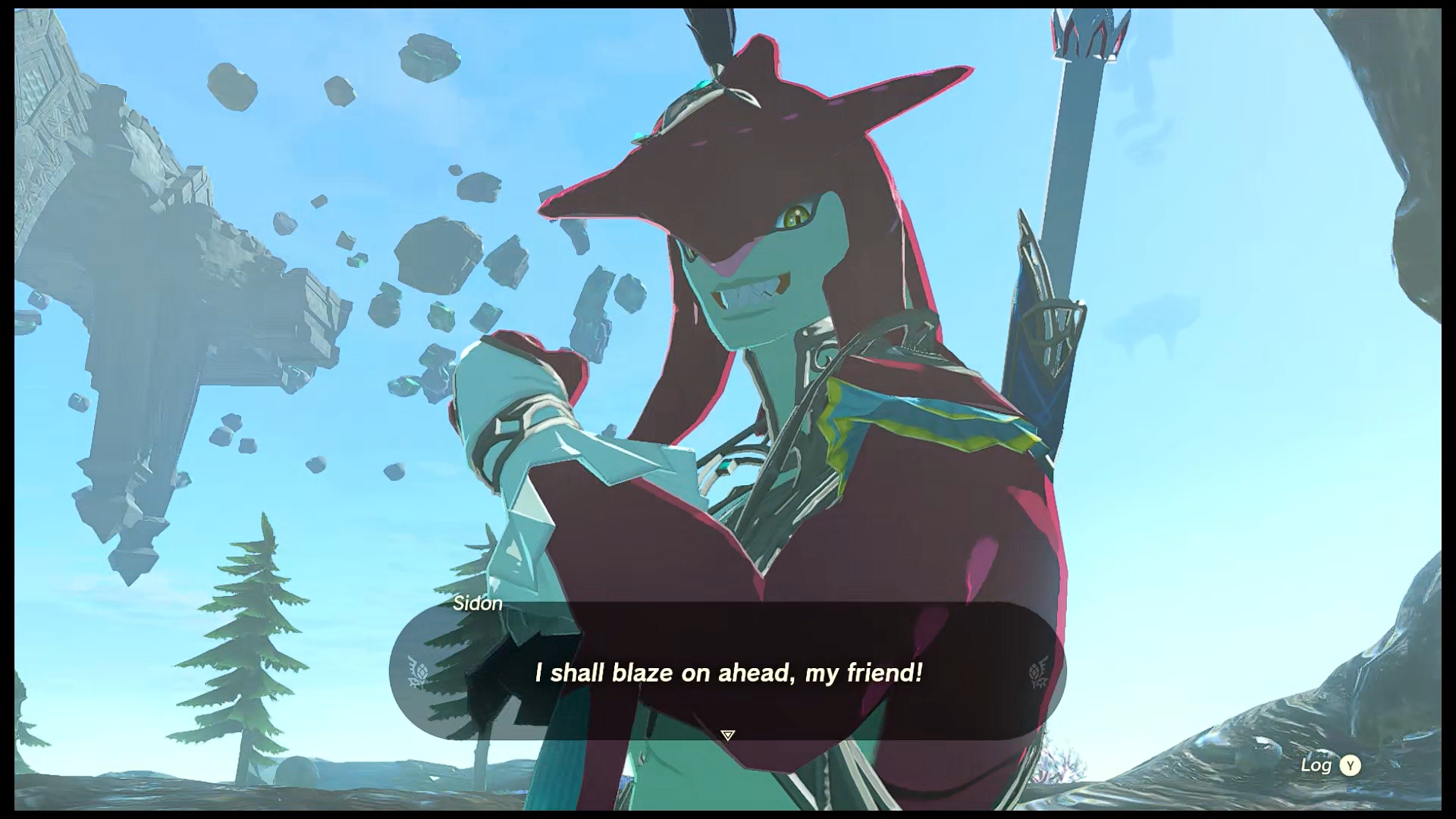
A little pedantic perhaps, but it just goes to show how much of the story languishes in the formula established by Breath of the Wild. Outside of this, the sequel’s narrative is definitely a marked improvement. There are multiple main questlines, all taking you in different directions and none of which obviously lead to your final confrontation with Ganondorf. Characters have more screen time and development, and helping the peoples of Hyrule is more nuanced than simply turning up and going straight to the dungeon.
The dungeons of the Zelda franchise have always been one of its strengths and Tears of the Kingdom does a lot to rectify the sour taste left in my mouth by Nintendo’s previous offering. Whilst they are still on the small side, they are much more epic in presentation. Jumping through the sky to reach an ark suspended at dizzying heights was a spectacle that exceeded anything from Breath of the Wild.
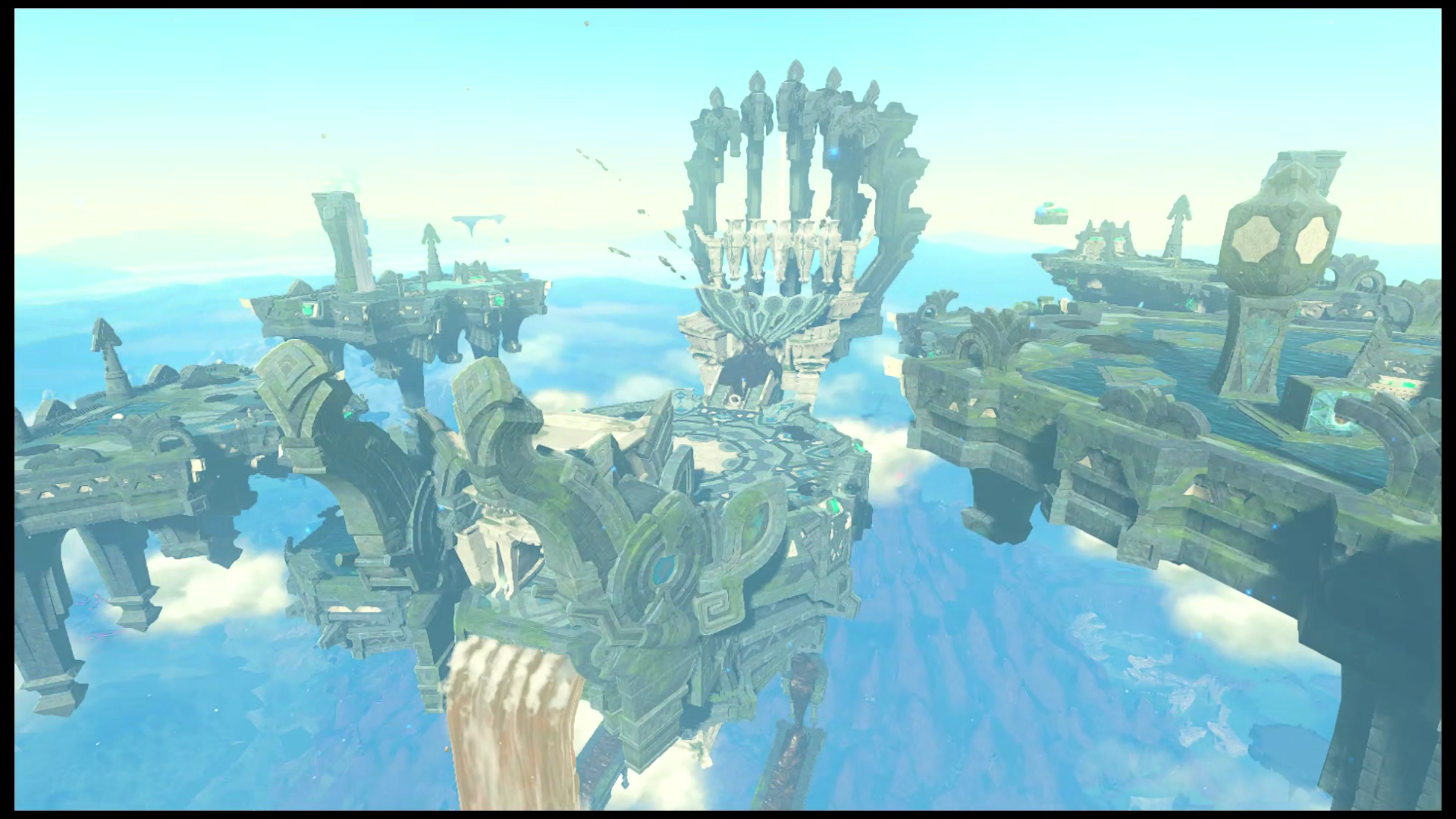
But while Tears of the Kingdom contains some memorable set pieces, on the moment to moment level it tends to fall short. One of the greatest things about BotW was the feeling of exploring its environment. Going far off the beaten path of the main quest, discovering the inlets and cliffs of the gorgeous southern coast of Hyrule was divine. Coming across a hidden shrine or small self-contained side quest left me feeling like an explorer discovering uncharted lands. These brief moments built up over the course of my time in Hyrule to create an over-arching theme of an epic adventure.
Booting up Tears of the Kingdom, I already intimately aware of the view from atop the Temple of Time. I have already found each of the sacred springs and the Great Plateau iss basically a second home to me. Knowing what lies over the next ridge lessens the experience of the journey in a game where so much of the time you spend playing is traversing. Instead, the first ten hours or so of my playthrough were all about the destination as I excitedly darted around the various landmarks of Hyrule, to see how the familiar had changed.
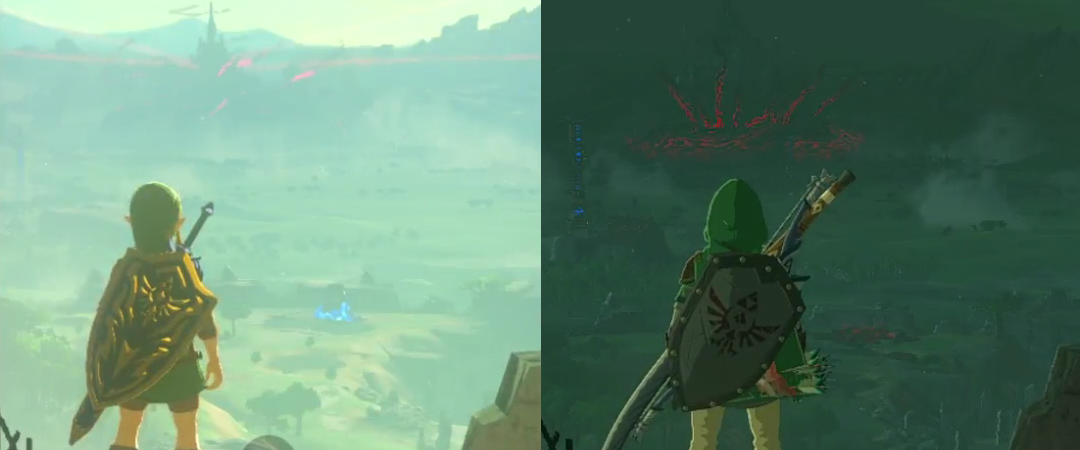
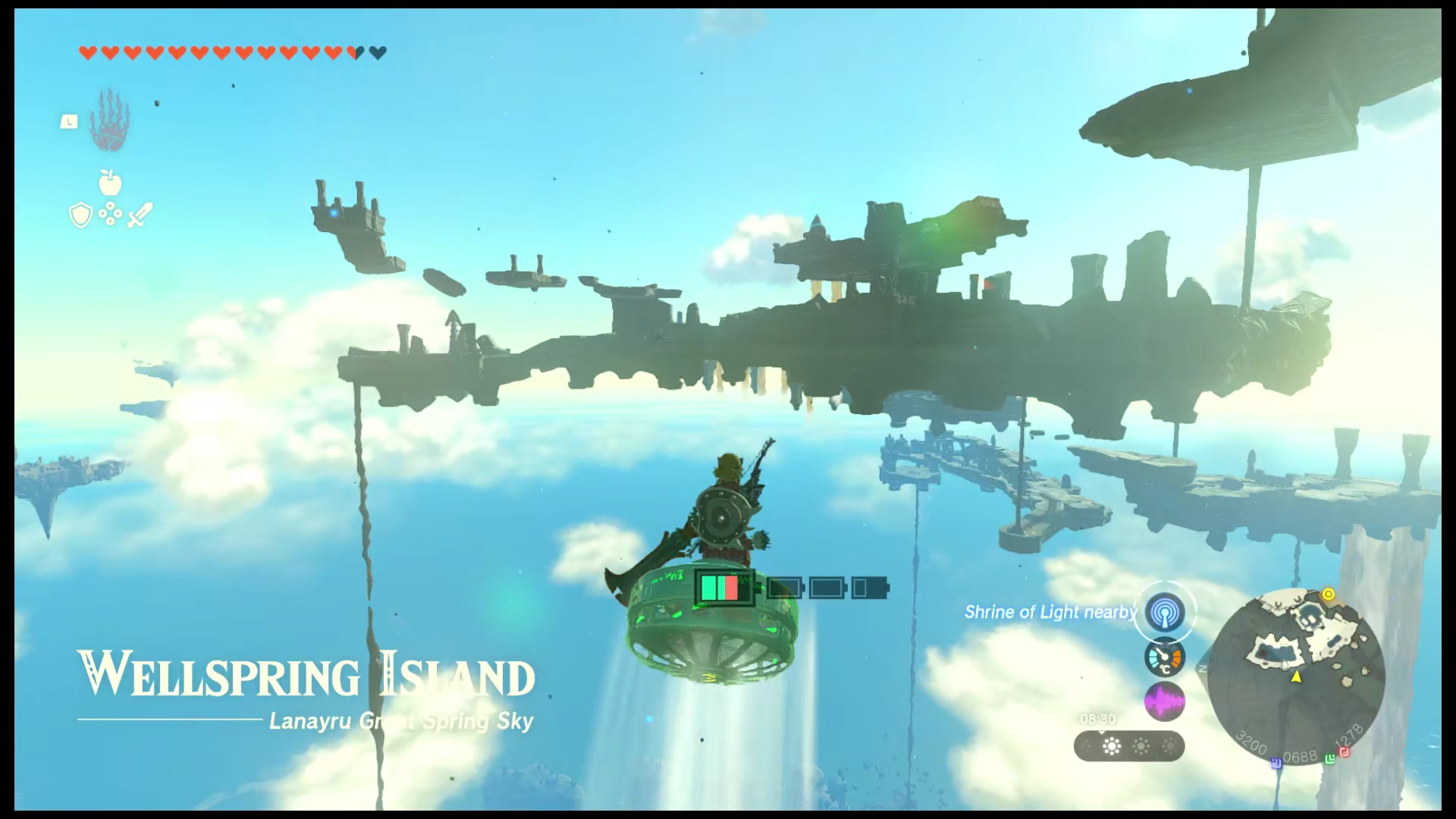
And things certainly look different. There’s been a massive increase in the crispness of models and the lighting has noticeably been improved to make everything pop. Additional areas to explore help stop the sequel feeling completely stale. Floating high above Hyrule is now a series of sky archipelagos filled with ancient technology and a frankly gorgeous gold and white colour palette. Deep below, accessible only by chasms the belch forth foul vapours, is the depths – a corrupted cavern system that spans the entire length and width of Hyrule.
The depths are a different type of fun. Claustrophobic and intense, exploring this new area is a gauntlet of endurance thanks to the new gloom mechanics. Later on as you are given more tools to deal with this the gloom become less scary but a thorough expedition always requires preparation and caution. That being said, as you reach new Lightroots and repel the encroaching darkness, the illuminated depths aren’t much to look at and start to feel monotonous.
In a stark contrast to the depths, the sky islands feel empty, which surprised me because, the skies featured more in the promotional material. The game begins on the Great Sky Island, the largest island availible. Exploring this first island captured some of what I love about BotW, but the expectation created by this first impression was at odds with the rest of the game. Once you leave that first island, the rest are little more than isolated clusters scattered across the map. Many of these clusters are simply variations of a few elements: a shrine quest, a dispenser to get your hands on a few zonai goodies and maybe a few enemies to fight. There’s a remarkable lack of bespoke content going on in Hyrule’s skies which begs the question as to what Nintendo spent six years working on.
The answer to this is obvious: Ultrahand. In creating TotK, Nintendo have clearly put a lot of time and effort into these mechanics. Some of the creations I have seen online, from giant mechanoids to arial drones to the aforementioned Korok torture devices all demonstrate the robustness of the system and there is a clear intelligence behind its design to for such creativity. I’m no programmer, but from what I have read from more learned folks, the physics engine alone is artistry. Interactions between objects are intuitive and if you think of some crazy creation, its more than likely that the mechanics will allow it. It’s easy to lose hours making and fine-tuning new contraptions.
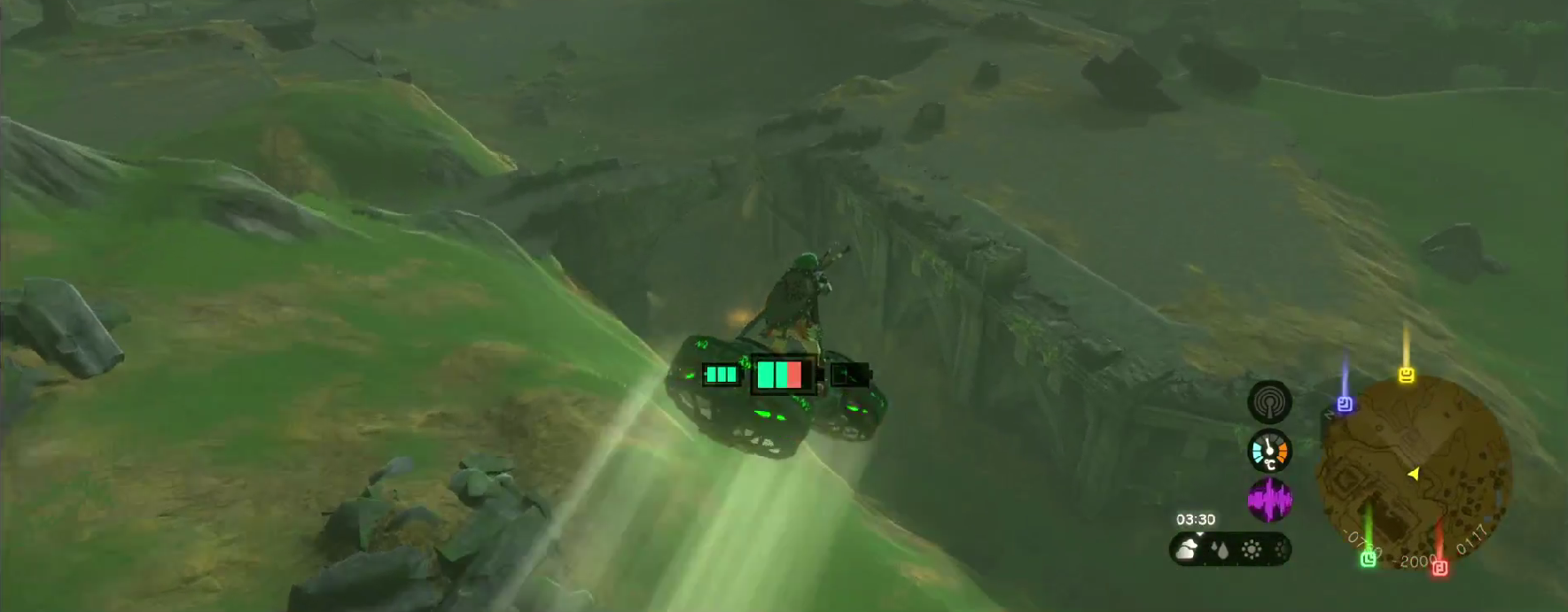
Alongside Ultrahand, Tears of the Kingdom introduces Fuse, the ability to attach items to your weapons, increasing their damage or adding elemental effects. This goes a long way in addressing the complains regarding the weapon degradation system in Breath of the Wild. Why would I engage with a gang of bokoblins when it risks breaking my hoard of weapons for very little reward. Well Nintendo has provided an answer: for sweet monster parts to create my next weapon. This simple change meant that I was wading into the thick of combat and when my blade broke, I could immediately craft a suitable replacement and get back into the action. This solution only got more viable as my time with the game grew and I stockpiled a collection of the most powerful monster parts.
There is a lot to love in the latest intallment in the Zelda frachise and it wasn’t until I was penning this review that I could pinpoint why it wasn’t hitting the mark. Almost every bit of praise or criticism I had for the game is in some way a reflection of what came before. The feeling of exploration is gone, the story takes a gigantic leap forward, every judgement was in some way coloured by my experiences with Breath of the Wild. Nintendo have become a victim of their own success and Tears of the Kingdom suffers under the weight of its predecessor. The new additions are great, but there’s too much of the old for it to truly shine.
Scores:
Story:
On one hand, Tears has shamelessly copied from the first game’s homework, on the other hand, it does it better. (7/10)
Gameplay:
There is much to love from the building mechanics to the fine-tuned approach to combat. It’s just a shame that traversing Hyrule has just lost its magic. (9/10)
Graphics:
The style is cohesive, the art direction incredibly. Hyrule is a genuine joy to explore. (9/10)
Overall: 8/10



 Elimbwrites.com
Leave a comment